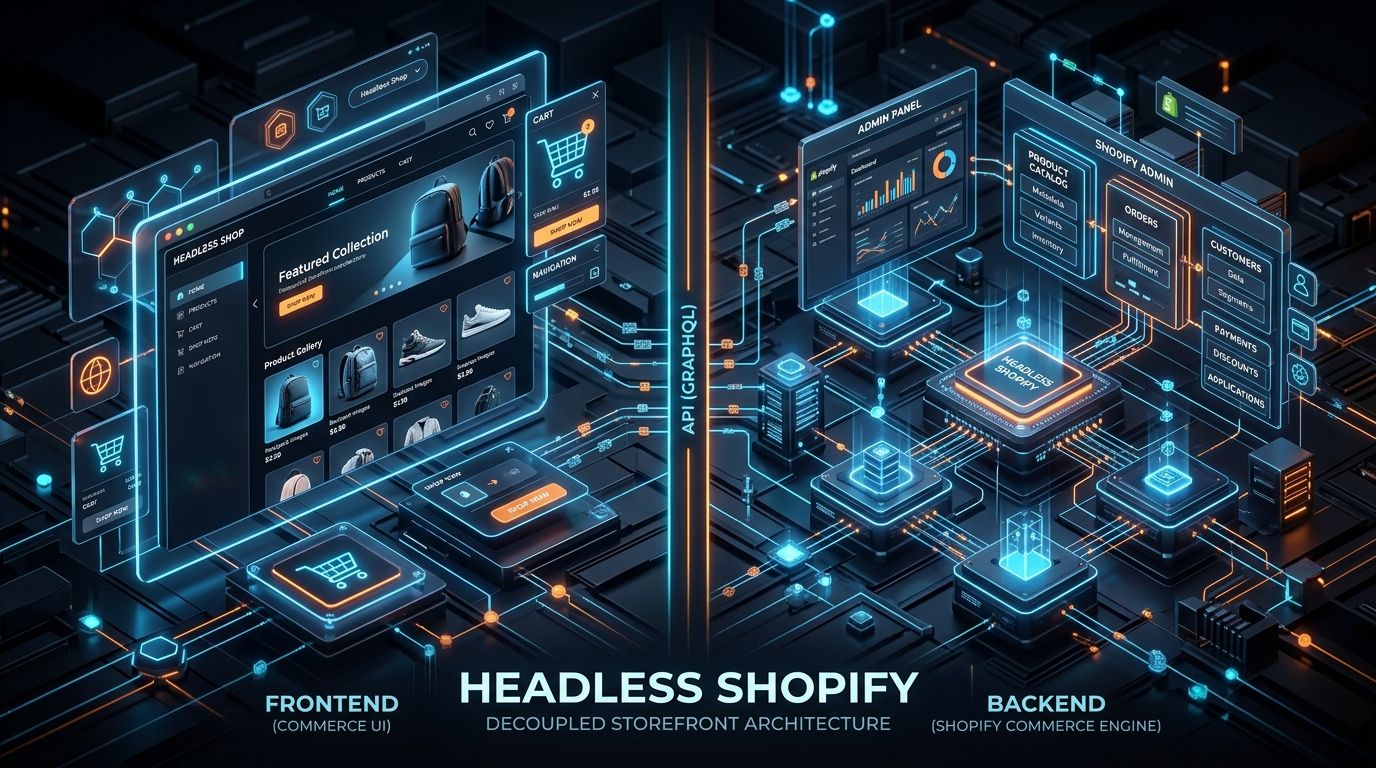
What is Headless Shopify? (And Why Everyone is Talking About It)
If you're running a growing eCommerce business in 2026, you've likely heard the term "headless" thrown around in every boardroom meeting. But what is a headless Shopify store, exactly? Let me break it down without the agency jargon.
Standard Shopify is a monolith. The backend (where your inventory, pricing, and checkout live) is tightly glued to the frontend (the theme your customers actually click on). It’s convenient, but it’s heavy.
Headless Shopifymeans completely severing that connection. You keep Shopify’s incredibly powerful, secure backend to process payments and manage inventory. However, you completely scrap Shopify’s Liquid templating engine for the frontend. Instead, you build a custom, blazing-fast storefront using modern frameworks likeNext.jsorReact, and connect the two via the Shopify Storefront API.
Shopify vs Headless Shopify: The Core Differences
When clients ask me to compare standard Shopify vs headless Shopify, it always comes down to three things: Speed, Flexibility, and SEO.
- Performance Limit:Standard Shopify themes carry immense technical debt. Apps bloat your code, JavaScript blocks rendering, and your Core Web Vitals suffer. With headless, you control every single byte of code sent to the browser.
- Customization:Standard themes lock you into rigid grids. Headless allows you to build multi-dimensional, interactive, app-like experiences that are simply impossible on a basic theme.
- Omnichannel:Headless allows you to push your Shopify products to a smart watch, an IoT device, or a completely custom mobile app seamlessly.
Is Headless Shopify Better for SEO?
The short answer? Absolutely yes. As an independent technical architect, I've audited hundreds of enterprise sites, and performance is the ultimate bottleneck.
Google’s Core Web Vitals are ruthless in 2026. A standard Shopify store loaded with 15 marketing apps will almost always fail the Largest Contentful Paint (LCP) and Interaction to Next Paint (INP) metrics. When you transition to a headless Shopify Next.js architecture, you utilize Server-Side Rendering (SSR) and Edge caching.
The result? Sub-second page loads. Google rewards this instantly. I've seen brands migrate to headless and watch their organic traffic double purely because they went from a 4-second load time to a 0.8-second load time.
Stop Guessing Your Vitals. Test Them.
Before you even think about migrating, you need to know exactly how bad your current theme is bleeding traffic. Run your current URL through myFree AI SEO Auditorto get a brutal, technical breakdown of why your site isn't converting.
Headless Shopify Pricing: What Does It Actually Cost in 2026?
This is where the Ahrefs search data shows the most anxiety:headless shopify pricing.Agencies love to hide these numbers, but I prefer transparency.
Because you are decoupling the system, you are essentially building a custom web application from scratch.
- The Build Cost:Hiring an elite headless Shopify developer or agency will typically run you between$25,000 and $80,000+for the initial build, depending on the complexity of your custom React storefront and 3rd-party API integrations (like custom Stripe checkouts).
- Hosting the Frontend:You will need to host your new Next.js storefront on infrastructure like Vercel or AWS. Expect $100 to $500/month for enterprise-grade Edge hosting.
- Maintenance:Because there are no "plug-and-play" Shopify apps anymore, you need a developer on retainer to build new features.
Build vs Buy: The Developer’s Shortcut
If that $50k agency price tag made you flinch, there is a better way. Instead of paying an agency for 100 hours of boilerplate setup, you can dramatically cut costs by starting with a production-ready foundation. If you have an in-house React developer, have them grab myNext.js Boilerplateto bypass the initial 20+ hours of routing and auth setup.
The Verdict: Is Headless Shopify Worth It?
If you are a boutique store doing $50k a year, stay on standard Shopify. The maintenance overhead of a custom React architecture will crush your margins.
However, if you are an enterprise or mid-market brand doing $1M+ annually, and you are losing conversions because your pages take 4 seconds to load on mobile—headless isn't just an option. It is a mandatory evolution to survive in the 2026 e-commerce landscape.
Ready to Scale Your E-Commerce Architecture?
If you are looking for a headless Shopify agency or a lead developer to architect this transition flawlessly, you're in the right place. I design, build, and deploy high-performance, enterprise-grade headless architectures that print money.
Book a discovery call with me today, and let's map out exactly what a Headless Next.js migration looks like for your brand.