The Brutal Truth About WooCommerce Migrations in 2026
Let me start with a harsh truth that most digital agencies will never tell you: If your WooCommerce brand is generating less than $3M to $5M in annual revenue, you probably shouldn't migrate to a headless stack.
The ROI simply isn't there. You are better off optimizing your existing monolithic PHP infrastructure, stripping out heavy plugins, and upgrading your hosting.
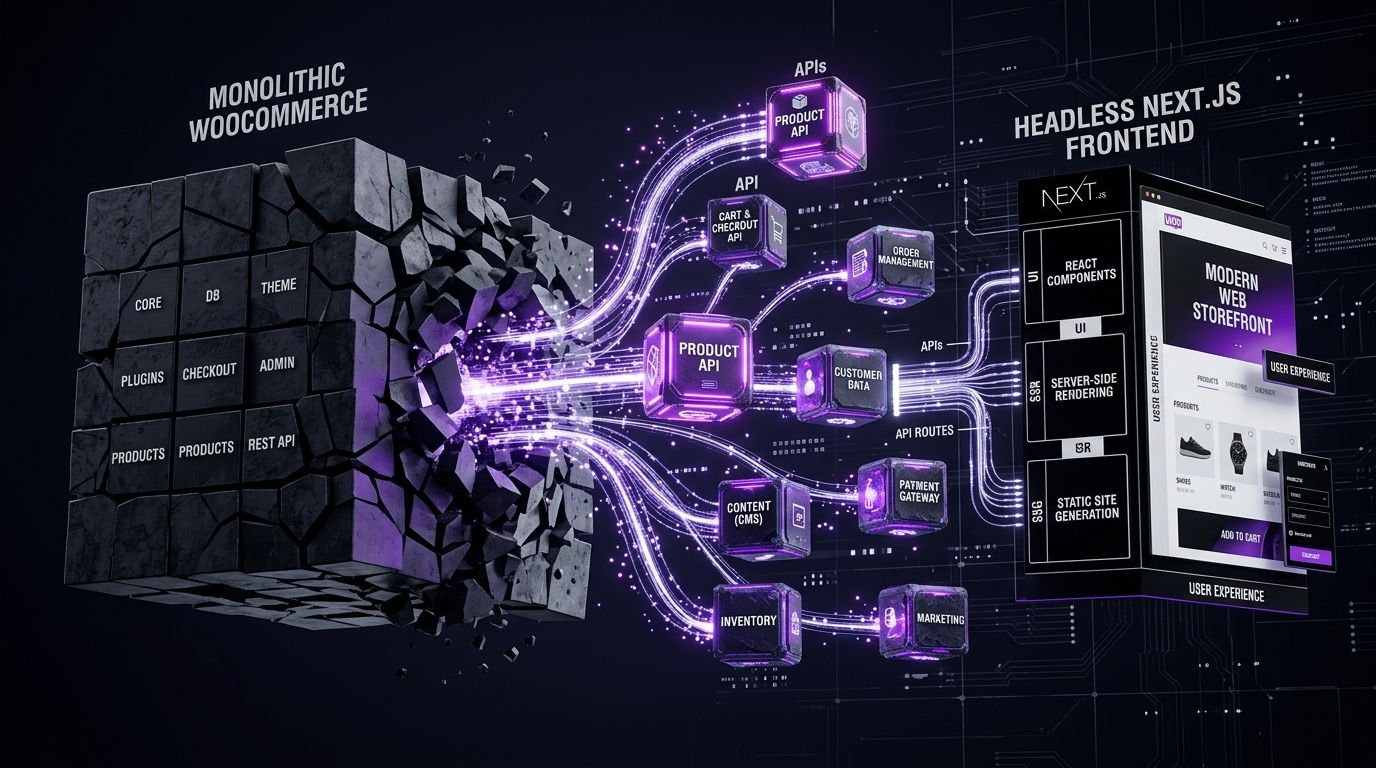
However, if youarean enterprise brand hitting the limits of WooCommerce—if your database is locking under high concurrent checkout volume, if your mobile pages take 4 seconds to load, or if you need to push products to custom mobile apps—then headless is your only path forward.
As a technical web architect, I've designed and executed these migrations. It is not a weekend project; it is a fundamental architectural overhaul. Here is the exact 4-phase technical roadmap I use to decouple WooCommerce without losing data or tanking SEO.
Phase 1: The Architecture Audit (Before You Touch Code)
A headless migration fails in the planning phase, not the execution phase. You cannot simply slap a Next.js frontend onto your existing WordPress database and expect it to work.
You must map every single third-party dependency. Are you using a complex WooCommerce subscriptions plugin? A custom tiered-pricing engine for B2B wholesale? Those PHP pluginswill not workon your new Next.js frontend unless they expose a robust REST or GraphQL API.
If they don't have an API, you must either write custom middleware to expose that data, or abandon the plugin and rebuild the logic in your new frontend. Map your dependencies first.
Phase 2: Decoupling the Data Layer (WPGraphQL)
To turn WooCommerce into a headless backend, we must expose its data efficiently. The standard WordPress REST API is too slow and over-fetches data for a modern e-commerce build.
Instead, we installWPGraphQLalong with theWooGraphQLextension. This transforms your monolithic database into a highly efficient graph, allowing your new Next.js frontend to request exactly the data it needs (e.g., just the product title and price, skipping the heavy meta descriptions) in a single query.
The Authentication Nightmare
This is where 90% of headless migrations stall: User Authentication. In a monolithic setup, WordPress handles session cookies automatically. In a headless setup, your Next.js app and your WordPress backend are on different domains.
You must implement JWT (JSON Web Tokens) or OAuth to handle secure logins, password resets, and cart persistence across sessions. Do not underestimate the complexity of rebuilding the "My Account" dashboard via API.
Phase 3: The Frontend Build (Next.js & Edge Caching)
With the backend APIs established, we build the custom storefront. In 2026,Next.js (App Router)is the undisputed king of headless commerce frontends.
By leveraging React Server Components (RSC) and Partial Pre-Rendering (PPR), we can serve the bulk of your product pages as instant, static HTML cached at the Edge, while streaming dynamic data (like cart totals and live inventory) asynchronously. This is how we achieve the holy grail of sub-second load times.
Skip the 40-Hour Setup Phase
Configuring Next.js, setting up the Apollo GraphQL client, and wiring secure JWT authentication from scratch takes massive engineering hours. If your team wants to skip the boilerplate and jump straight to building custom UI, you can start with my production-readyNext.js Boilerplate.
Phase 4: ETL Migration and Zero-Downtime SEO
If you are migrating to a completely new backend (like Shopify Plus or Medusa.js) instead of keeping WooCommerce headless, you must run an ETL (Extract, Transform, Load) script. This maps your complex SQL database rows (products, variations, users) into the new system's schema.
Finally, the most critical step:The 301 Redirect Architecture.
If your URL structure changes (e.g., from/shop/product-nameto/products/product-name), you must map a 1-to-1 redirect for every single page on your site. If you miss this, Google will drop your rankings overnight, and your migration will be a financial disaster.
Don't Risk Your Enterprise Data
A headless migration is the most complex transition an e-commerce brand can undertake. It requires deep expertise in database architecture, GraphQL, and edge network routing.
Don't risk your data integrity or your organic traffic on an agency learning as they go. I architect and execute zero-downtime headless migrations for enterprise brands.
Book a technical discovery call with me today, and let's map out a secure roadmap for your transition.