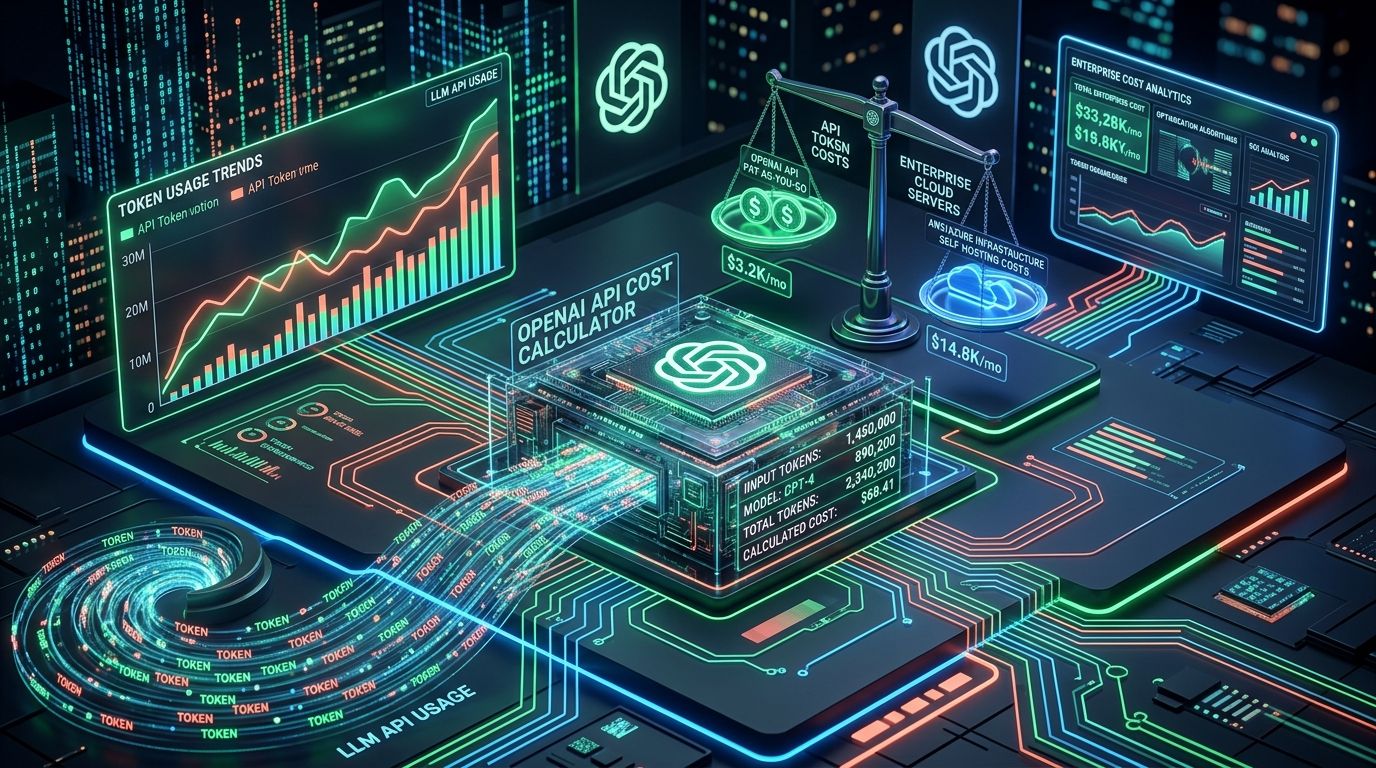
Building an enterprise AI application is exciting until the end of the month arrives and your team receives a surprise $15,000 OpenAI invoice. In the early prototyping phase, spending a few dollars testing prompts feels negligible. But when you transition from a local sandbox to hundreds of thousands of live production users querying Retrieval-Augmented Generation (RAG) pipelines, agentic workflows, and document parsers, token economics can quickly make or break your business model.
Over my 12+ years of architecting scalable web applications and custom web development solutions, I have built and audited dozens of enterprise LLM integrations. Whether you are building automated workflows like AI-driven insurance claims pipelines or customer-facing copilots, understanding OpenAI's API pricing structure is mandatory to ensure healthy gross margins.
In this architectural breakdown, I demystify OpenAI API token pricing, evaluate the flagship GPT-4o / GPT-4.1 frontier model tiers against competitors (Anthropic Claude 3.5/3.7, Google Gemini 1.5/2.0, and open-source Llama 3.3), calculate real-world monthly costs at scale, and share the exact caching and routing strategies I use to slash production API bills by 60% to 80%.
Quick Answer: Is the GPT-4 / GPT-4.1 API Worth the Cost?
Yes, for complex multi-step reasoning, code generation, and mission-critical decision logic, GPT-4 frontier models remain the industry gold standard. However, using flagship models for routine extraction, classification, or simple conversational chat is a massive financial mistake. By pairing prompt caching (50-90% discount), the Batch API (50% discount), and model cascading (routing simple tasks to mini/flash models), you get frontier-level intelligence at a fraction of the cost.
| Model Tier | Standard Input (per 1M) | Cached Input (per 1M) | Output Tokens (per 1M) | Context Window | Best Enterprise Use-Case |
|---|---|---|---|---|---|
| GPT-4o (Flagship) | $2.50 | $1.25 (50% off) | $10.00 | 128,000 tokens | Complex reasoning, multimodal vision, coding, high-stakes decisions |
| GPT-4o-mini (Efficiency) | $0.15 | $0.075 (50% off) | $0.60 | 128,000 tokens | High-volume classification, summarization, customer support chatbots |
| OpenAI o1 / o1-mini (Reasoning) | $3.00 – $15.00 | $1.50 – $7.50 | $12.00 – $60.00 | 128,000 tokens | Mathematical proofs, deep architectural synthesis, complex logic |
| Claude 3.5 Sonnet (Anthropic) | $3.00 | $0.30 (90% off) | $15.00 | 200,000 tokens | Artifact generation, coding benchmarks, long-document extraction |
| Gemini 1.5 / 2.0 Flash (Google) | $0.075 | $0.01875 (75% off) | $0.30 | 1,000,000+ tokens | Ultra-large document processing, low-cost video/audio ingestion |
| Llama 3.3 70B (Self-Hosted) | ~$0.30 (Compute eq.) | N/A (KV Cache) | ~$0.80 (Compute eq.) | 128,000 tokens | Strict HIPAA/SOC2 data sovereignty & zero per-token vendor lock-in |
Understanding Tokenomics: How OpenAI Charges for API Usage
To understand your invoice, you must first understand the concept of tokens. In the English language, 1 token is roughly equivalent to 4 characters or 0.75 words. A standard 1,000-word blog post or corporate contract is approximately 1,333 tokens.
OpenAI separates API billing into three distinct consumption vectors:
1. Input Tokens (Prompt Tokens)
Input tokens represent the data you send TO the model. This includes your system prompt, developer instructions, few-shot examples, retrieved RAG context documents, and the user's question. Input tokens are significantly cheaper than output tokens because the GPU can process them in parallel in a single forward pass.
2. Output Tokens (Completion Tokens)
Output tokens represent the words GENERATED by the model in response. Output tokens are 3x to 4x more expensive than input tokens because language models generate text autoregressively (one token at a time). Generating long JSON structures, verbose essays, or detailed reports directly drives up your bill.
3. Vision and Multimodal Tokens
When passing images or PDF page scans into GPT-4o, OpenAI tiles the image into 512x512 pixel patches. A standard high-resolution screenshot (e.g., 1080p dashboard or invoice) typically consumes 765 to 1,105 tokens ($0.002 to $0.003 per image). Processing 50,000 invoice images per month translates to roughly $150 in vision token fees alone.
Prompt Caching: The Biggest Cost Saver in Modern LLM Architecture
One of the most important architectural upgrades introduced by OpenAI and Anthropic is automatic Prompt Caching. If your prompt exceeds 1,024 tokens and shares an identical prefix with previous requests (e.g., your permanent system instructions, tool definitions, or static RAG documentation), OpenAI automatically caches the KV (Key-Value) states.
- Cache Read Discount: Cached input tokens receive a 50% discount on OpenAI ($1.25 per 1M tokens on GPT-4o) and up to 90% discount on Claude 3.5 Sonnet ($0.30 per 1M tokens).
- Zero Configuration Required: OpenAI automatically detects static prompt prefixes and applies the cache discount on requests submitted within 5 to 10 minutes.
- Latency Reduction: Cached prompts bypass initial GPU pre-fill computations, slashing Time to First Token (TTFT) by up to 80%.
Real-World Enterprise Cost Scenarios: Modeling 1M Requests
To illustrate how architecture affects your monthly bill, let's model three common enterprise production workloads:
Scenario A: Naive Architecture (Unoptimized GPT-4o)
A customer support assistant processes 100,000 inquiries per month. Each request includes a 2,000-token un-cached RAG prompt and generates a 400-token response:
- Input: 100k requests × 2,000 tokens = 200M input tokens × $2.50/M = $500.00
- Output: 100k requests × 400 tokens = 40M output tokens × $10.00/M = $400.00
- Monthly Total: $900.00 / month ($0.009 per user interaction)
Scenario B: Scaled Document Processing (1 Million Invoices)
An accounts payable platform processes 1,000,000 invoices per month. Each invoice contains 3,000 input tokens and outputs a 300-token structured JSON schema:
- Using GPT-4o directly: (3B input tokens × $2.50/M) + (300M output tokens × $10.00/M) = $7,500 + $3,000 = $10,500.00 / month
- Using GPT-4o-mini with Batch API: (3B input × $0.075/M) + (300M output × $0.30/M) = $225 + $90 = $315.00 / month
- Architectural Savings: $10,185.00 / month (97% reduction) with identical JSON extraction accuracy!
Architectural Blueprint: Implementing Semantic Caching in Next.js
To prevent duplicate LLM invocations and slash API spend, enterprise architectures deploy a Semantic Cache using vector embeddings and Redis/Upstash. When building custom SaaS dashboards in Next.js 15, incoming queries are compared against previous answers. If a semantic match exceeds a 0.95 cosine similarity threshold, the cached answer is returned in 15ms at $0 cost:
// Example: Next.js 15 Semantic Caching Layer for OpenAI API Calls
import { OpenAI } from 'openai';
import { Redis } from '@upstash/redis';
import { VectorIndex } from '@/lib/vector';

const openai = new OpenAI({ apiKey: process.env.OPENAI_API_KEY });
const redis = Redis.fromEnv();
const vectorDb = new VectorIndex();

export async function queryOptimizedLLM(userQuery: string) {
  // 1. Generate lightweight embedding for the incoming query
  const embeddingRes = await openai.embeddings.create({
    model: 'text-embedding-3-small',
    input: userQuery,
  });
  const queryVector = embeddingRes.data[0].embedding;

  // 2. Check semantic cache for near-identical historical queries
  const cacheHit = await vectorDb.query({
    vector: queryVector,
    topK: 1,
    minScore: 0.96, // 96% semantic similarity threshold
  });

  if (cacheHit && cacheHit.length > 0) {
    const cachedResponse = await redis.get(cacheHit[0].id);
    if (cachedResponse) {
      return { answer: cachedResponse, source: 'SEMANTIC_CACHE', cost: 0.00 };
    }
  }

  // 3. Cache Miss: Execute GPT-4o with prompt-cached system instructions
  const response = await openai.chat.completions.create({
    model: 'gpt-4o',
    messages: [
      { role: 'system', content: 'You are an enterprise technical architect...' }, // Static prefix cached
      { role: 'user', content: userQuery },
    ],
    temperature: 0.2,
  });

  const answer = response.choices[0].message.content;

  // 4. Store in vector cache asynchronously
  const responseId = `resp:${Date.now()}`;
  await Promise.all([
    redis.set(responseId, answer, { ex: 86400 * 7 }), // 7 day TTL
    vectorDb.upsert({ id: responseId, vector: queryVector }),
  ]);

  return { answer, source: 'OPENAI_API', usage: response.usage };
}
5 Proven Strategies to Cut Your OpenAI API Bill by 70%
If your monthly AI expenses are growing faster than your revenue, implement these five battle-tested engineering optimizations:
- Implement Dynamic Model Routing (Cascading): Never send 100% of traffic to GPT-4o. Use a lightweight router (like GPT-4o-mini or a fine-tuned small model) to evaluate query complexity. Route 80% of simple tasks to mini ($0.15/M) and reserve flagship GPT-4o ($2.50/M) exclusively for edge cases requiring deep reasoning.
- Leverage the Batch API for Async Workflows: If your use case does not require real-time streaming (e.g., nightly report generation, bulk data enrichment, backlink analysis, or document classification), submit requests via the OpenAI Batch API for an automatic 50% discount.
- Structure System Prompts for Maximum Cache Hits: Ensure your static system prompt, schema definitions, and few-shot examples are placed at the very beginning of the message array. Never inject dynamic variables (like user names or current timestamps) before the static prefix, as this invalidates the KV cache.
- Constrain Output Token Verbosity with Structured Outputs: Use JSON Schema mode (`response_format: { type: 'json_object' }`) and explicit field limits. Instruct models to respond in compact keys rather than conversational prose, saving thousands of costly completion tokens.
- Hybrid Deployment with Self-Hosted Open-Source Models: For high-volume internal tasks, deploy quantized open-source models (like Llama 3.3 70B or Mistral NeMo) on dedicated cloud GPUs (vLLM on RunPod/AWS). Use OpenAI solely as a fallback for complex edge cases.
Conclusion: Engineering Sustainable AI Margins
The GPT-4 API is one of the most powerful developer tools in software history, but treating it as a black box with unmetered consumption will rapidly destroy your SaaS unit economics. True enterprise engineering is not just about writing clean prompts—it is about designing intelligent caching, routing, and fallback architectures that deliver frontier intelligence while protecting your bottom line.
If you are designing an enterprise AI platform, scaling a RAG pipeline, or require senior technical consulting on your cloud architecture, explore my Custom Web Development & AI Architecture Services or calculate your development scope with our free AI Scope & Proposal Generator.