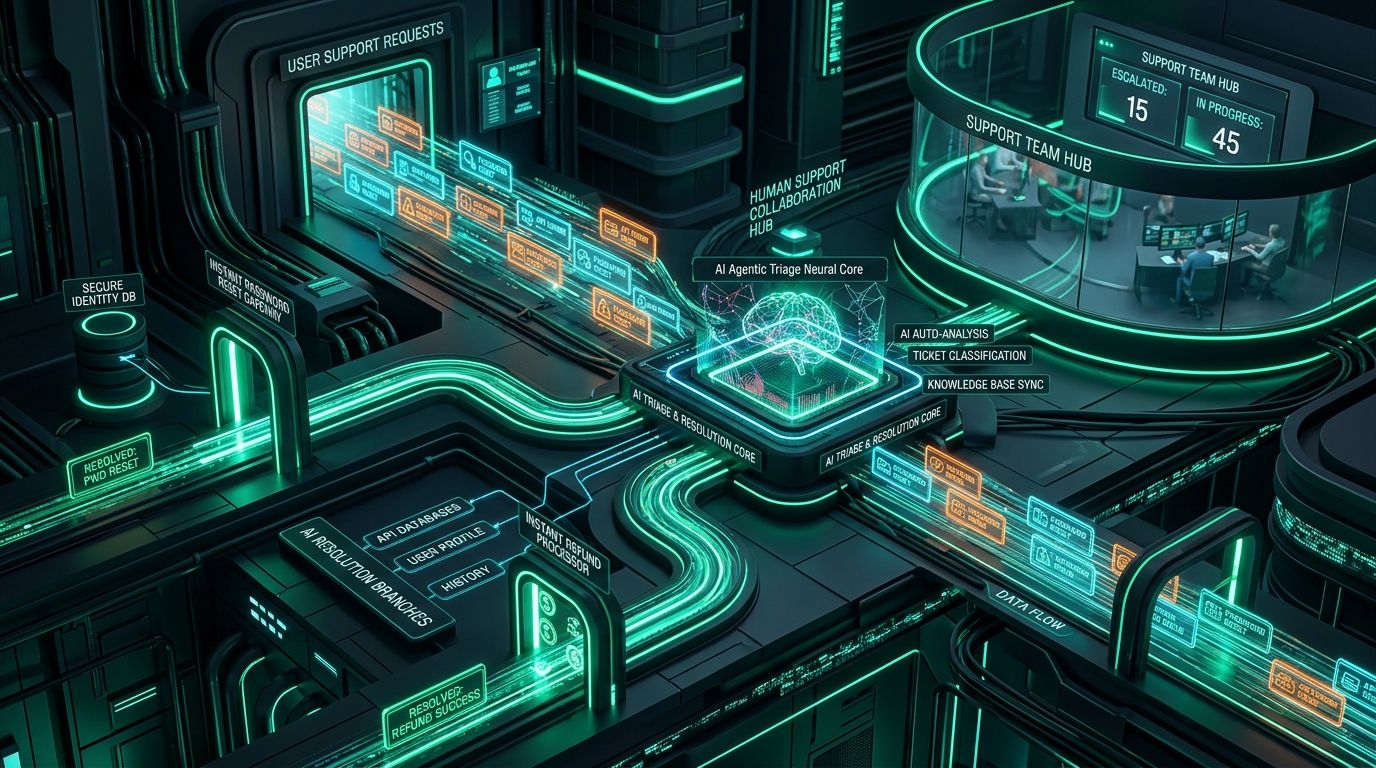
In high-growth B2B SaaS companies and digital enterprises, customer support queues are notoriously prone to operational gridlock. As your user base expands from 10,000 to 500,000 active accounts, incoming ticket volume scales exponentially. Human support teams find themselves drowning in repetitive Tier-1 requests: password resets, invoice lookups, basic permission updates, and subscription cancellations.
Industry data shows that manually resolving a single support ticket costs between $15 to $45 in direct staffing and tooling expenses. Over my 12+ years of architecting enterprise systems and custom web development architectures, I have seen organizations make the critical mistake of deploying frustrating, generic 'keyword chatbots' that simply dump documentation links on unhappy users. Real support automation is fundamentally different: it is about Agentic AI taking deterministic actions on behalf of the customer.
Modern AI helpdesk automation connects Large Language Models (LLMs) directly to your production APIs, identity providers, and billing gateways. The result? 80% of routine customer and internal IT support tickets are resolved autonomously in under 45 seconds—with zero human agent involvement.
In this comprehensive technical guide, I break down the 80/20 support automation framework, the 4-layer agentic architecture required for touchless resolution, how to prevent hallucinations using semantic RAG, and how to build a production-ready AI support agent in Next.js 15.
Quick Definition: What is Helpdesk Automation?
Helpdesk automation is the use of artificial intelligence, natural language understanding, Retrieval-Augmented Generation (RAG), and backend API tool-calling to categorize, investigate, and autonomously resolve customer support and internal IT tickets without manual human intervention.
| Evaluation Vector | Legacy Human-Driven Helpdesk | Autonomous AI Agentic Helpdesk |
|---|---|---|
| First Response Time (FRT) | 2 to 6 hours | Sub-15 seconds (24/7/365) |
| Average Resolution Time (TTR) | 18 to 36 hours | Sub-2 minutes (for automated Tier-1 issues) |
| Average Cost per Resolved Ticket | $15.00 – $45.00 in labor | $0.20 – $0.80 in API compute |
| Tier-1 Resolution Capability | Requires human reading & typing | Autonomous API execution (Password reset, refunds, role updates) |
| Escalation Context Handoff | User forced to re-explain problem | Full conversation summary & telemetry passed to human |
| Handling Traffic Spikes (Outages) | Queue backlog builds for days | Infinite concurrent capacity with zero wait time |
| Customer Satisfaction (CSAT) | 62% – 74% (Frustration with wait times) | 88% – 95% (Instant instant resolution) |
The 80/20 Rule: What Tickets Should AI Actually Resolve?
The goal of helpdesk automation is not to replace human empathy—it is to eliminate repetitive administrative friction so your human engineers and customer success managers can focus on high-stakes, nuanced enterprise escalations. Roughly 80% of all support volume falls into four highly automatable buckets:
1. Identity & Access Management (30% of Volume)
- SSO / MFA reset requests: Verifying user identity via push notification or secondary email and triggering automated Auth0/Okta token resets.
- Role-based permission provisioning: Automatically granting temporary GitHub repository access, Slack channel invites, or CRM viewer seats based on approved manager rules.
2. Billing, Invoices & Subscription Management (25% of Volume)
- Invoice PDF retrieval: Querying Stripe/Paddle API to generate download links for past billing periods.
- Pro-rated refund execution: Applying automated refund policies for accidental renewals within 48 hours without human review.
- Seat adjustment & plan upgrades: Updating database customer tiers programmatically upon user confirmation.
3. Product Troubleshooting & Diagnostic RAG (15% of Volume)
- Extracting answers from documentation, API reference guides, and release notes to solve integration errors.
- Analyzing user-submitted error logs and console stack traces using AI code parsers.
4. Order Tracking & Transaction Status (10% of Volume)
- Real-time shipment tracking, webhook status verification, and delivery date estimates.
The 4-Layer Agentic Helpdesk Architecture
Building an enterprise-grade AI helpdesk requires four decoupled technical layers:
Layer 1: Intent Triage & Sentiment Classification
When a user submits a ticket (via chat, email, or Slack), a lightweight classification model instantly evaluates the message. It extracts the primary intent (`BILLING_REFUND`, `AUTH_RESET`, `BUG_REPORT`), detects sentiment (frustrated vs neutral), and calculates an emergency severity score.
Layer 2: Grounded Semantic RAG Knowledge Base
To prevent hallucinations, the model never relies on public training data alone. It queries a private vector database containing your product documentation, troubleshooting guides, and approved macros. As I discussed in my guide on OpenAI API Token Optimization, implementing semantic caching ensures common questions are answered in milliseconds at zero token cost.
Layer 3: Tool-Calling & Deterministic API Execution
This is where true 'Agentic AI' separates from traditional chatbots. The AI possesses structured functions (tools) that allow it to safely execute actions against your backend services (e.g., `executeRefund(userId, invoiceId)`, `resetApiKey(orgId)`). The model generates the JSON arguments, while your server validates and executes the command securely.
Layer 4: Smart Human-in-the-Loop (HITL) Escalation
If a user's sentiment turns aggressive, if a ticket involves an edge-case contract dispute, or if the confidence score drops below 85%, the system immediately triggers a smooth handoff to Zendesk, Intercom, or Jira Service Management. The human agent receives a concise 3-bullet AI summary of the issue and the exact diagnostic steps already attempted.
Architectural Blueprint: Building an Autonomous Support Agent in Next.js 15
When developing AI customer portals using modern React and Next.js 15 architectures, developers implement Server Actions with structured LLM tool-calling. Here is a production-ready architectural blueprint of an AI support router that analyzes a ticket, checks user authorization, and executes an automated billing action:
// Example: Next.js 15 Server Action for Autonomous AI Helpdesk Resolution with Tool-Calling
'use server';

import { z } from 'zod';
import { OpenAI } from 'openai';
import { stripeClient } from '@/lib/stripe';
import { db } from '@/lib/database';

const openai = new OpenAI({ apiKey: process.env.OPENAI_API_KEY });

const SupportTicketSchema = z.object({
  userId: z.string().uuid(),
  userEmail: z.string().email(),
  ticketText: z.string().min(5),
});

export async function processHelpdeskTicket(formData: FormData) {
  const parsed = SupportTicketSchema.safeParse({
    userId: formData.get('userId'),
    userEmail: formData.get('userEmail'),
    ticketText: formData.get('ticketText'),
  });

  if (!parsed.success) {
    return { success: false, error: 'Invalid support request payload.' };
  }

  // 1. Define executable backend tools for the AI Agent
  const tools: OpenAI.Chat.Completions.ChatCompletionTool[] = [
    {
      type: 'function',
      function: {
        name: 'issue_invoice_refund',
        description: 'Issues a refund for the most recent charge if within policy (under 7 days old)',
        parameters: {
          type: 'object',
          properties: {
            reason: { type: 'string', description: 'User stated reason for refund' },
          },
          required: ['reason'],
        },
      },
    },
    {
      type: 'function',
      function: {
        name: 'escalate_to_human_engineer',
        description: 'Escalates complex technical bugs or high-touch enterprise issues to human tier-2',
        parameters: {
          type: 'object',
          properties: {
            summary: { type: 'string', description: 'Concise summary of user problem' },
            urgency: { type: 'string', enum: ['LOW', 'HIGH', 'CRITICAL'] },
          },
          required: ['summary', 'urgency'],
        },
      },
    },
  ];

  // 2. Invoke LLM with System Grounding and Tool Definitions
  const response = await openai.chat.completions.create({
    model: 'gpt-4o',
    messages: [
      {
        role: 'system',
        content: 'You are an autonomous tier-1 technical support engineer for an enterprise SaaS platform...',
      },
      { role: 'user', content: parsed.data.ticketText },
    ],
    tools,
    tool_choice: 'auto',
  });

  const message = response.choices[0].message;

  // 3. Handle Tool Execution
  if (message.tool_calls && message.tool_calls.length > 0) {
    const toolCall = message.tool_calls[0];

    if (toolCall.function.name === 'issue_invoice_refund') {
      // Execute verified deterministic Stripe refund
      const refundResult = await stripeClient.refundLatestCharge(parsed.data.userId);

      await db.supportLogs.create({
        data: {
          userId: parsed.data.userId,
          status: 'AUTO_RESOLVED_REFUND',
          details: refundResult,
        },
      });

      return {
        success: true,
        resolutionType: 'TOUCHLESS_REFUND',
        message: 'Your refund of $' + refundResult.amount + ' has been processed to your original payment method.',
      };
    }

    if (toolCall.function.name === 'escalate_to_human_engineer') {
      const args = JSON.parse(toolCall.function.arguments);

      await db.supportEscalations.create({
        data: {
          userId: parsed.data.userId,
          summary: args.summary,
          urgency: args.urgency,
          status: 'QUEUED_FOR_HUMAN',
        },
      });

      return {
        success: true,
        resolutionType: 'HUMAN_ESCALATION',
        message: 'Your issue has been escalated to our senior engineering team with priority: ' + args.urgency,
      };
    }
  }

  // 4. Standard Informational RAG Response
  return {
    success: true,
    resolutionType: 'INFORMATIONAL_ANSWER',
    message: message.content,
  };
}
Essential Metrics: How to Measure True Support ROI
When measuring the success of your automated helpdesk, never rely solely on 'Deflection Rate.' A deflection is meaningless if the customer gave up in frustration and churned. Instead, track these four healthy engineering KPIs:
- Autonomous Resolution Rate (ARR): The percentage of total tickets where the AI executed an action or answered a query and the user marked the issue resolved with zero human touch (Target: 70% – 85%).
- 7-Day Re-Contact Rate: The percentage of users who reopen a ticket on the same topic within 7 days. A healthy automated system maintains a re-contact rate below 4%.
- Customer Effort Score (CES): Post-resolution surveys asking: 'How easy was it to get your issue resolved today?' (Target: 4.6 / 5.0).
- Human Agent Burnout & Retention: Measure the decrease in repetitive Tier-1 tickets handled by your senior staff, allowing them to focus on high-value enterprise accounts.
Conclusion: Turning Customer Support into a Competitive Advantage
Helpdesk automation is not about building walls to keep customers away from your team—it is about providing instantaneous, 24/7 resolution for routine requests while empowering human agents to deliver white-glove service when it matters most.
Whether you are building custom AI agents, integrating LLM tool-calling with your billing systems, or exploring enterprise web development consulting, explore my technical architecture services or calculate your engineering scope with our free AI Scope & Proposal Generator.